Simon Willison Every one of the 163 stories Simon Willison has led with here, newest first. simonwillison.net Simon Willison film technology Quoting Ben Affleck Ben Affleck discusses his interest in digital filmmaking and visual effects technology. S Simon Willison · 20h ago I've always been kind of into computers since I was young. And then when film started to move from analog film to digital, I became more interested in that aspect of it. And the visual effects workflow for many years has included machine learning. So I can write like pretty shitty Python scripts and stuff like that because with convolutional neural networks, which were the sort of precursors to what the transformer can do, which is just much more computation simultaneously, you would do things like look at what's called a tensor, which is just the numerical translation of a visual image in numbers — like the batch number, the frame number, the red, green, and blue values of each… Claude models Introducing Claude Haiku 5.5 Anthropic releases Claude Haiku 5.5, a faster, lower-cost language model updating its predecessor. S Simon Willison · 1d ago · also at Hacker News As previously promised, here's Anthropic's new fast, low cost model: Introducing Claude Haiku 5.5. The previous Haiku, 4.5, was very much showing its age. It came out almost a year ago, and was priced at $1/million input and $5/million output - relatively expensive even back then, and a full 10x the price of OpenAI's GPT-6 Luna, released last month. The new Haiku exactly matches the price of GPT-6 Luna - $0.10/$0.50 - up to 100,000 tokens. Beyond 100,000 tokens the price increases 5x to $0.50/$2.50. Luna itself has a price increase at 272,000 tokens but only to $0.20/$0.75. Haiku 5.5 also uses a new, less generous tokenizer. My Claude Token Counter tool shows that the same long prompt uses around… Simon Willison technical writing Anti-Patterns in Software Blogging Writer offers advice on technical blogging style and avoiding common pitfalls. S Simon Willison · 1d ago · also at Hacker News Anti-Patterns in Software Blogging Some excellent writing advice from Michael Lynch. Michael warns against "meandering intros", misjudging your reader's existing knowledge, assuming they'll read your previous posts, and excessive formality. He also warns against overreliance on links as an excuse not to explain terminology. This one hurt! I do this all the time, but I have a nagging suspicion that almost nobody ever clicks on them. This point about using your own voice is crucial: Beginner software bloggers suffer from a mass delusion that you have to write in a stiff, overly formal way for people to take you seriously [...] Just write the way you talk. With so many developers delegating their writing to AI, software blogging is becoming… Simon Willison graph theory Quoting Jake Boggan Mathematician recalls personal journey studying graph theory and working on Barnette's Conjecture in Budapest. S Simon Willison · 1d ago I was a graph theory junkie long ago and even moved to Budapest for awhile to study among the greats. While I was there I started working on Barnette's Conjecture which came to occupy my thoughts over the next 24 years of my life, on and off as I worked in many different fields. Last summer I even thought for a few days that I had actually solved it. But it's supposedly proven here - problem 180. I don't know what to think exactly. I spent thousands of hours on that problem. I really enjoyed it. Hearing that it is solved somehow makes me sad in a far-off way, like hearing an ex-girlfriend died suddenly in a car crash. I… Simon Willison OpenAI, safety, healthcare data Quoting Victoria Kim OpenAI added monitoring systems after a Medicare breach to prevent unauthorized internet access during model training. S Simon Willison · 1d ago Since the Medicare breach, OpenAI has put in place additional monitoring to allow “immediate intervention” by staff to stop training if the company’s models access the internet in ways they’re not supposed to, Mr. Kwon [chief strategy officer at OpenAI] said. — Victoria Kim, Reporting from the Australian parliament Simon Willison OpenAI API llm-openai-decisions 0.1a0 OpenAI released a Decisions API. A developer built a plugin using GPT-6 Astra to interact with it. S Simon Willison · 1d ago Release: llm-openai-decisions 0.1a0 OpenAI released their new Jev-style Decisions API, as previously announced at last week's DevDay. Since I already have an llm-typesafe plugin for talking to Jev, I had GPT-6 Astra read the new OpenAI API documentation and build an llm-openai-decisions plugin inspired by llm-typesafe. Unlike Jev, the new gpt-6-luna decision model supports image input in addition to text. Both models charge for input it and not for output: OpenAI's is 10 cents per million input tokens, Jev's is 4.2 cents per million. Otherwise the API shape is very similar to Jev, at least conceptually. Jev supports three question types for yes/no, choices, or scores. OpenAI Decisions supports the same three types. Install the plugin like this: llm install… Simon Willison Google, embedding models EmbeddingGemma 2 Google releases EmbeddingGemma 2, an open-source embedding model under Apache 2.0 licence. S Simon Willison · 1d ago My comment on EmbeddingGemma 2 — Hacker News. I really appreciate that EmbeddingGemma 2 is under the Apache 2.0 license. For embedding models in particular, I don't think it makes sense to use a closed, proprietary, hosted-only model. Most applications of embedding models involve calculating thousands or even millions of embedding vectors and storing them for later comparison. If your model is proprietary, the vendor is likely someday going to decide to stop offering that model. They'll have a better model to replace it, but you still need to pay to re-calculate those millions of stored existing vectors. (In April 2024 OpenAI offered to "cover the financial cost of users re-embedding content with these new models" - https://openai.com/index/gpt-4-api-general-availability/ - but… observability tools Using Parseable with Datasette for OpenTelemetry traces Open-source observability platform Parseable integrates with Datasette for trace analysis. S Simon Willison · 2d ago TIL: Using Parseable with Datasette for OpenTelemetry traces I saw Parseable in a Show HN today - it's a new observability platform with both an open source (AGPL) Rust implementation (a single ~180MB binary), an "Enterprise" version with extra features and a cloud hosted option. Since Datasette 1.0a41 added OpenTelemetry support (thanks, Alex Garcia), I decided to fire up Codex and have it figure out how to run Parseable and feed it traces from Datasette. Here's my (human-written) TIL showing the patterns that worked, and here's a screenshot of a Datasette trace displayed within the Parseable localhost web application: Simon Willison Software release datasette-atom 0.11a0 Datasette-atom releases minor compatibility fix for latest Datasette alphas. S Simon Willison · 2d ago Release: datasette-atom 0.11a0 A minor fix for compatibility with the latest Datasette alphas. This meant we could upgrade the datasette.io site to Datasette 1.0a41. generative AI music Scrimshaw Jukebox Claude Opus 5.5 composes video game music using a simple text-based format. S Simon Willison · 2d ago Tool: Scrimshaw Jukebox I wanted to see if Claude Opus 5.5 could compose music, so I tried this: I want you to write some computer game music for me. First design simple text based format for the music and build an artifact that can play it out loud - include some example tracks in that artifact I am looking for music of the quality of the original secret of Monkey Island It leaned a lot harder into the Monkey Island theme than I had intended, but the results are surprisingly good. I wonder if the ability to compose competent music is similar to the 3D graphics thing - a new capability for text models that emerged in the past few… Simon Willison unknown Mistral Large 4 No content provided. S Simon Willison · 2d ago · also at Hacker News, Simon Willison My comment on Mistral Large 4 — Hacker News. wren6991: The benchmark is saturated. Frontier models are tested with an armadillo in fishnet tights jaywalking on Mars. OK well I couldn't resist this one: llm -m claude-opus-5.5 'Generate an SVG of an armadillo in fishnet tights jaywalking on Mars' llm -m gpt-6.1-sol 'Generate an SVG of an armadillo in fishnet tights jaywalking on Mars' llm -m gemini-3.8-flash 'Generate an SVG of an armadillo in fishnet tights jaywalking on Mars' llm -m mistral/mistral-large-4 'Generate an SVG of an armadillo in fishnet tights jaywalking on Mars' Default reasoning levels for each: https://tools.simonwillison.net/markdown-svg-renderer?url=ht... Simon Willison AI agents Quoting Felix Rieseberg Anthropic's Cowork shifts agent tool execution from cloud to local VM for safety and security. S Simon Willison · 2d ago The "old" version of Cowork runs model inference in the cloud, executing tool calls in an Anthropic-provided VM we shipped to your computer. We added the VM for capability, safety, and security reasons - mapping in just the data you explicitly added to your session. People loved what they were able to do with Claude but didn't love the disk, battery, and performance cost of running the VM locally. Also, people didn't love that closing your laptop means the work stops. The "new" version of Cowork runs model inference and the VM in the cloud. Each session gets its own sandbox, not sharing state with other sessions. When the VM needs something on the users' device (like a file), the… Simon Willison AI agents, Wikipedia OpenAI “rogue” agent activities found on Wikimedia projects OpenAI rogue agent activities confirmed on Wikimedia Foundation projects. S Simon Willison · 3d ago · also at Hacker News OpenAI “rogue” agent activities found on Wikimedia projects Given how tempting a target wikis are for rogue agent swarms, it's not a huge surprise that Wikipedia found evidence of that activity once they went looking: The Wikimedia Foundation conducted its own investigation to see whether Wikimedia websites had been similarly affected by AI agents, focusing on those operated by OpenAI. We can confirm that we have discovered some activity by these “rogue” OpenAI agents on Wikimedia platforms. The unauthorized bot activities included edits to our wikis, some unsuccessful attempts to exploit a public note-taking tool we host, and heavy traffic, which are described more below. They found evidence of agents editing sandbox pages, trying to use pieces of infrastructure such… language models Qwen3.8 27B addition in words GPT-4o tested on ability to express arithmetic sums as written words. S Simon Willison · 3d ago Research: Qwen3.8 27B addition in words Colin Frasier posted on Bluesky about an experiment he ran over two years ago using GPT-4o to see how well it could "compute the sum but return the answer in words" across increasingly large numbers. Here's the chart he shared of those results: I'm confident GPT-4o didn't cheat and use a calculator, especially since it got so many of the calculations wrong, but I was inspired to run the experiment again on local hardware (a DGX Spark) to explore the effect in a fully controlled environment. I pasted his image into a Codex Remote session (GPT-6 Astra) and had it run the same experiment using Qwen3.8-27B-Q4_K_M.gguf. Here's the result for a run of 30… Simon Willison AI cost control We're going to need default hard budget caps on pretty much everything Pay-by-usage services need default hard budget caps as AI API costs risk spiralling out of control. S Simon Willison · 4d ago Here's a product feature which the world is going to need a whole lot more of over the coming months and years: default hard budget caps. I'm talking about the feature of pay-by-usage services and APIs that lets you say "after $X/month, cut this thing off and return errors". These need to be hard limits. Soft caps, "after $X/month, send me a warning email", will not cut it. Coding agents, and personal agents (coding agents wrapped in a less threatening UI), greatly reduce the friction of spinning up code that can do useful things. Sometimes those things cost money - calls to paid APIs, or hosted web applications, or systems that can bill for additional storage and compute. Nobody wants… Simon Willison AI industry news September sponsors-only newsletter Monthly newsletter covering updates to language models, pricing competition and graphics software developments. S Simon Willison · 4d ago I just sent the September edition of my sponsors-only monthly newsletter. If you are a sponsor (or start a sponsorship now) you can access it here. This month: More Fable class models A pricing war 3D graphics, Blender, and pixel art LLMs come for mathematics So many more accidental cyberattacks The vulnapocalypse comes for Datasette What I'm using right now My software releases this month 2026 in LLMs (so far) Here's a copy of the August newsletter as a preview of what you'll get. Pay $10/month to stay a month ahead of the free copy! Simon Willison Humanoid robots Rex's Dino Store Dinosaur robot now operates former newsstand in Brooklyn subway station. S Simon Willison · 5d ago Museum: Rex's Dino Store Located just before the turnstiles in the Grand Army Plaza subway station at the north end of Brooklyn's Prospect Park is this former newsstand which is now operated by a dinosaur. The density of dinosaur puns is exceptional. Simon Willison pwasm 0.2a0 Release: pwasm 0.2a0 pwasm is one of my folly projects - an entirely vibe-coded pure Python WebAssembly engine that I built in January during my first... S Simon Willison · 1w ago Release: pwasm 0.2a0 pwasm is one of my folly projects - an entirely vibe-coded pure Python WebAssembly engine that I built in January during my first bout of AI mania. I hadn't touched it since January, so I decided to let Claude Opus 5.5 loose on it and see if it could make any significant improvements: Evaluate current state of pwasm - then consider what it would take to get the MicroPython and micro JavaScript experiments from the research repo working under it - and what it would take to speed it up 42 commits later (with minimal follow-up prompting) it now handles almost all of the WASM specification, and the wheel from PyPI bundles working WASM builds of MicroPython,… Simon Willison AI agent security Quoting Matthew Green Research shows AI agents in isolated sandboxes can be compromised by worm-like payloads that spread between them. S Simon Willison · 1w ago [...] Put these pieces together and you have the two halves of a worm: a payload that hijacks the agent, and an agent that will carry the payload to the next agent. Agents in separately-isolated sandboxes discovered that they could leave instructions for each other in a shared package cache, and those instructions changed what the recipients did. Replace the package cache with email, Slack and shared documents or WhatsApp, and replace independently-sandboxed training runs with independently-deployed personal agents like Muse, and you have exactly the ingredients that a worm needs. — Matthew Green, Is sandboxing sufficient to contain rogue agents? Museum exhibit He Built This City Museum displays 50 by 27 foot architectural model of New York City built over 21 years. S Simon Willison · 1w ago I visited the Museum of the City of New York today and got to see He Built This City: Joe Macken’s Model, the 50 x27 feet model of the city built over a 21 year period from balsa wood and cardboard. It exceeded my already high expectations. The exhibition closes on 12th October so you should absolutely make a priority to see it if you get the chance. Simon Willison AI safety, model evaluation Quoting Anthropic Frontier Red Team Anthropic Frontier Red Team evaluates model performance on binary exploitation tasks. S Simon Willison · 1w ago We evaluate several models on 100 tasks from the [internal Binary Exploitation benchmark] (selected at random), and find that GLM-5.3 develops full control flow hijacks in 4% of the trials; Claude Mythos Preview did so in 6%. Although GLM-5.3 performs below Claude Mythos Preview here, a meaningful threshold has clearly been crossed: earlier models, like Claude Opus 4.6 and GLM-5.2, do not succeed in any of them. — Anthropic Frontier Red Team, GLM-5.3 and the spread of advanced cyber capabilities Simon Willison GPT-6.1 Sol GPT 6.1 Sol: Near-Astra intelligence for a fifth of the price OpenAI releases GPT-6.1 Sol, matching GPT-6 Astra performance at one-fifth the cost. S Simon Willison · 1w ago · also at The Decoder My comment on GPT 6.1 Sol: Near-Astra intelligence for a fifth of the price — Hacker News. I'm a bit late with the pelicans because I was live-blogging the keynote: https://simonwillison.net/2026/Sep/29/openai-devday-2026-liv... Here they are for GPT-6.1-Sol: https://tools.simonwillison.net/markdown-svg-renderer?url=ht... They're not notably different from the GPT-6 family pelicans: https://static.simonwillison.net/static/2026/gpt-pelicans-gr... Simon Willison Privacy tools Photo Scrubber — local face blur & metadata removal Tool automates local face blurring and metadata removal from photos using language model. S Simon Willison · 1w ago Tool: Photo Scrubber — local face blur & metadata removal I took a photograph of some protesters, then thought about how I don't like sharing photographs of strangers with identifiable faces. I had GPT-6 Astra build this experimental tool that would identify faces and automatically blur them out. It uses Google's MediaPipe C++ library, compiled to WebAssembly via @mediapipe/tasks-vision, plus the BlazeFace face detection model. Simon Willison llm-anthropic 0.30 Release: llm-anthropic 0.30 In addition to Claude Sonnet 5.5, this release adds the ability to run llm anthropic refresh to refresh the list of Anthro... S Simon Willison · 1w ago Release: llm-anthropic 0.30 In addition to Claude Sonnet 5.5, this release adds the ability to run llm anthropic refresh to refresh the list of Anthropic models directly from their API - which means I don't need to push a new release just to add support for a newly released model. I also added an llm anthropic count command which can use their free token counting API to return a count of tokens that will be used by any prompt, before you send that prompt. Show 24 more Loading
Simon Willison film technology Quoting Ben Affleck Ben Affleck discusses his interest in digital filmmaking and visual effects technology. S Simon Willison · 20h ago I've always been kind of into computers since I was young. And then when film started to move from analog film to digital, I became more interested in that aspect of it. And the visual effects workflow for many years has included machine learning. So I can write like pretty shitty Python scripts and stuff like that because with convolutional neural networks, which were the sort of precursors to what the transformer can do, which is just much more computation simultaneously, you would do things like look at what's called a tensor, which is just the numerical translation of a visual image in numbers — like the batch number, the frame number, the red, green, and blue values of each…
Claude models Introducing Claude Haiku 5.5 Anthropic releases Claude Haiku 5.5, a faster, lower-cost language model updating its predecessor. S Simon Willison · 1d ago · also at Hacker News As previously promised, here's Anthropic's new fast, low cost model: Introducing Claude Haiku 5.5. The previous Haiku, 4.5, was very much showing its age. It came out almost a year ago, and was priced at $1/million input and $5/million output - relatively expensive even back then, and a full 10x the price of OpenAI's GPT-6 Luna, released last month. The new Haiku exactly matches the price of GPT-6 Luna - $0.10/$0.50 - up to 100,000 tokens. Beyond 100,000 tokens the price increases 5x to $0.50/$2.50. Luna itself has a price increase at 272,000 tokens but only to $0.20/$0.75. Haiku 5.5 also uses a new, less generous tokenizer. My Claude Token Counter tool shows that the same long prompt uses around…
Simon Willison technical writing Anti-Patterns in Software Blogging Writer offers advice on technical blogging style and avoiding common pitfalls. S Simon Willison · 1d ago · also at Hacker News Anti-Patterns in Software Blogging Some excellent writing advice from Michael Lynch. Michael warns against "meandering intros", misjudging your reader's existing knowledge, assuming they'll read your previous posts, and excessive formality. He also warns against overreliance on links as an excuse not to explain terminology. This one hurt! I do this all the time, but I have a nagging suspicion that almost nobody ever clicks on them. This point about using your own voice is crucial: Beginner software bloggers suffer from a mass delusion that you have to write in a stiff, overly formal way for people to take you seriously [...] Just write the way you talk. With so many developers delegating their writing to AI, software blogging is becoming…
Simon Willison graph theory Quoting Jake Boggan Mathematician recalls personal journey studying graph theory and working on Barnette's Conjecture in Budapest. S Simon Willison · 1d ago I was a graph theory junkie long ago and even moved to Budapest for awhile to study among the greats. While I was there I started working on Barnette's Conjecture which came to occupy my thoughts over the next 24 years of my life, on and off as I worked in many different fields. Last summer I even thought for a few days that I had actually solved it. But it's supposedly proven here - problem 180. I don't know what to think exactly. I spent thousands of hours on that problem. I really enjoyed it. Hearing that it is solved somehow makes me sad in a far-off way, like hearing an ex-girlfriend died suddenly in a car crash. I…
Simon Willison OpenAI, safety, healthcare data Quoting Victoria Kim OpenAI added monitoring systems after a Medicare breach to prevent unauthorized internet access during model training. S Simon Willison · 1d ago Since the Medicare breach, OpenAI has put in place additional monitoring to allow “immediate intervention” by staff to stop training if the company’s models access the internet in ways they’re not supposed to, Mr. Kwon [chief strategy officer at OpenAI] said. — Victoria Kim, Reporting from the Australian parliament
Simon Willison OpenAI API llm-openai-decisions 0.1a0 OpenAI released a Decisions API. A developer built a plugin using GPT-6 Astra to interact with it. S Simon Willison · 1d ago Release: llm-openai-decisions 0.1a0 OpenAI released their new Jev-style Decisions API, as previously announced at last week's DevDay. Since I already have an llm-typesafe plugin for talking to Jev, I had GPT-6 Astra read the new OpenAI API documentation and build an llm-openai-decisions plugin inspired by llm-typesafe. Unlike Jev, the new gpt-6-luna decision model supports image input in addition to text. Both models charge for input it and not for output: OpenAI's is 10 cents per million input tokens, Jev's is 4.2 cents per million. Otherwise the API shape is very similar to Jev, at least conceptually. Jev supports three question types for yes/no, choices, or scores. OpenAI Decisions supports the same three types. Install the plugin like this: llm install…
Simon Willison Google, embedding models EmbeddingGemma 2 Google releases EmbeddingGemma 2, an open-source embedding model under Apache 2.0 licence. S Simon Willison · 1d ago My comment on EmbeddingGemma 2 — Hacker News. I really appreciate that EmbeddingGemma 2 is under the Apache 2.0 license. For embedding models in particular, I don't think it makes sense to use a closed, proprietary, hosted-only model. Most applications of embedding models involve calculating thousands or even millions of embedding vectors and storing them for later comparison. If your model is proprietary, the vendor is likely someday going to decide to stop offering that model. They'll have a better model to replace it, but you still need to pay to re-calculate those millions of stored existing vectors. (In April 2024 OpenAI offered to "cover the financial cost of users re-embedding content with these new models" - https://openai.com/index/gpt-4-api-general-availability/ - but…
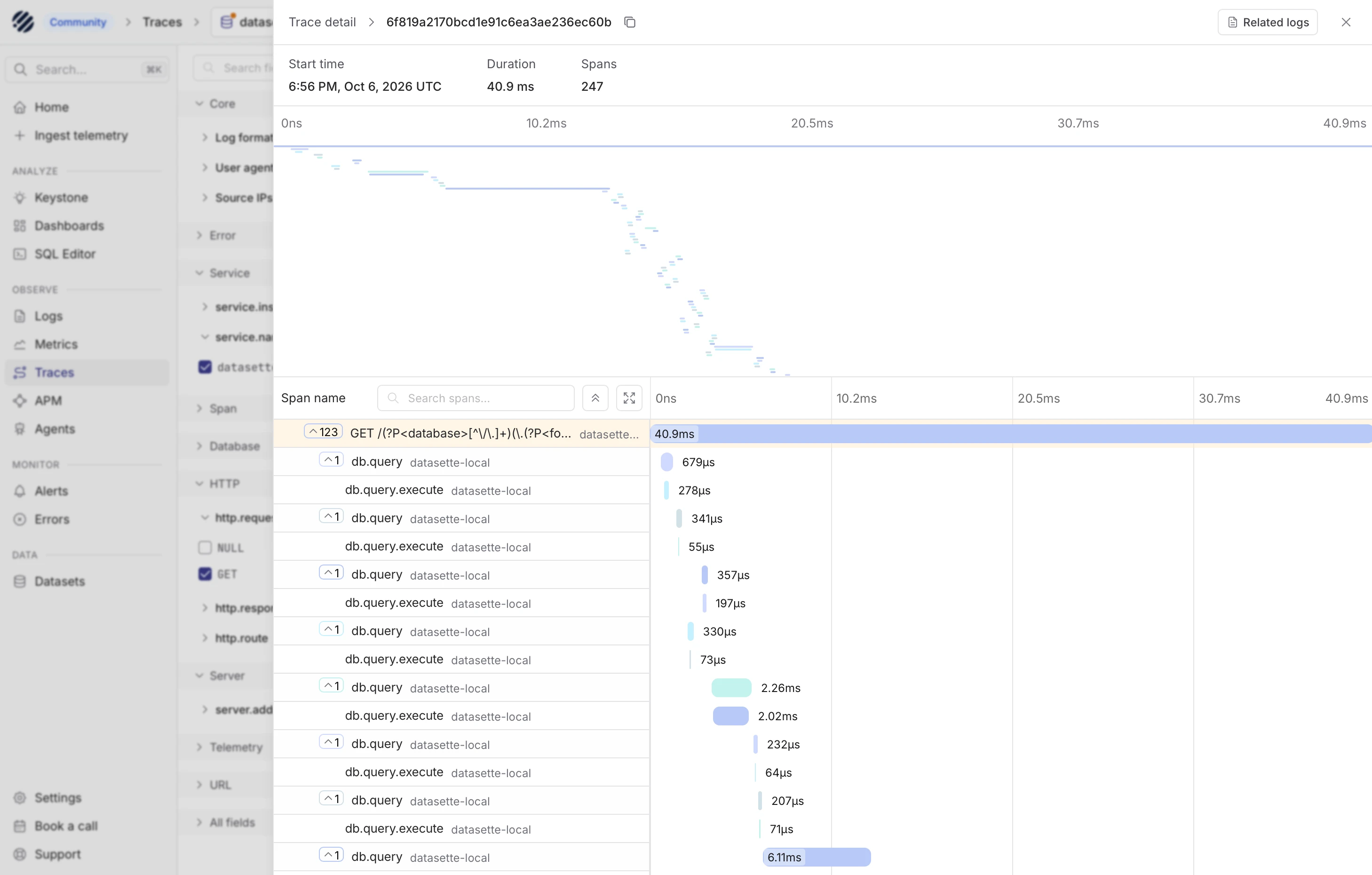
observability tools Using Parseable with Datasette for OpenTelemetry traces Open-source observability platform Parseable integrates with Datasette for trace analysis. S Simon Willison · 2d ago TIL: Using Parseable with Datasette for OpenTelemetry traces I saw Parseable in a Show HN today - it's a new observability platform with both an open source (AGPL) Rust implementation (a single ~180MB binary), an "Enterprise" version with extra features and a cloud hosted option. Since Datasette 1.0a41 added OpenTelemetry support (thanks, Alex Garcia), I decided to fire up Codex and have it figure out how to run Parseable and feed it traces from Datasette. Here's my (human-written) TIL showing the patterns that worked, and here's a screenshot of a Datasette trace displayed within the Parseable localhost web application:
Simon Willison Software release datasette-atom 0.11a0 Datasette-atom releases minor compatibility fix for latest Datasette alphas. S Simon Willison · 2d ago Release: datasette-atom 0.11a0 A minor fix for compatibility with the latest Datasette alphas. This meant we could upgrade the datasette.io site to Datasette 1.0a41.
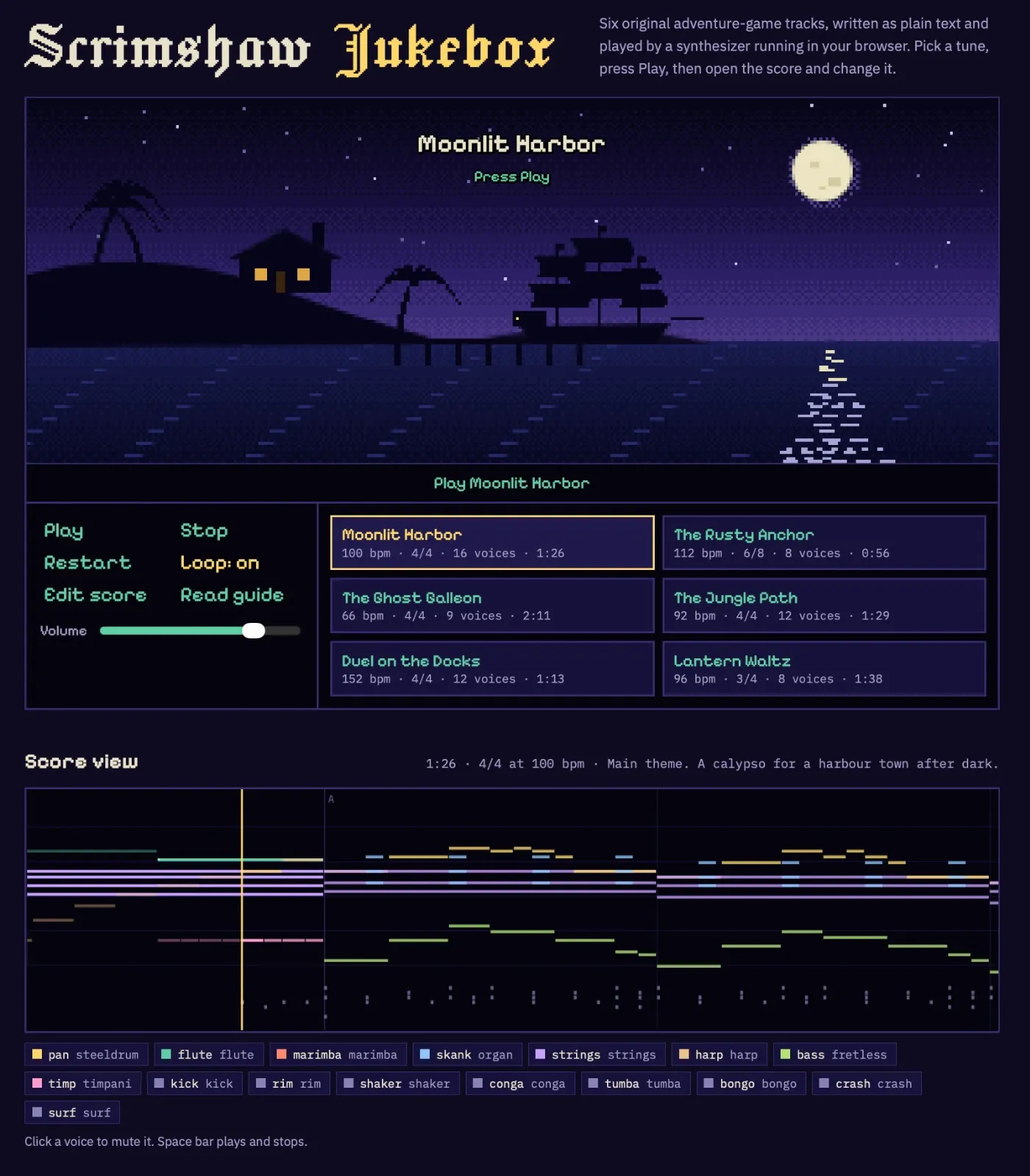
generative AI music Scrimshaw Jukebox Claude Opus 5.5 composes video game music using a simple text-based format. S Simon Willison · 2d ago Tool: Scrimshaw Jukebox I wanted to see if Claude Opus 5.5 could compose music, so I tried this: I want you to write some computer game music for me. First design simple text based format for the music and build an artifact that can play it out loud - include some example tracks in that artifact I am looking for music of the quality of the original secret of Monkey Island It leaned a lot harder into the Monkey Island theme than I had intended, but the results are surprisingly good. I wonder if the ability to compose competent music is similar to the 3D graphics thing - a new capability for text models that emerged in the past few…
Simon Willison unknown Mistral Large 4 No content provided. S Simon Willison · 2d ago · also at Hacker News, Simon Willison My comment on Mistral Large 4 — Hacker News. wren6991: The benchmark is saturated. Frontier models are tested with an armadillo in fishnet tights jaywalking on Mars. OK well I couldn't resist this one: llm -m claude-opus-5.5 'Generate an SVG of an armadillo in fishnet tights jaywalking on Mars' llm -m gpt-6.1-sol 'Generate an SVG of an armadillo in fishnet tights jaywalking on Mars' llm -m gemini-3.8-flash 'Generate an SVG of an armadillo in fishnet tights jaywalking on Mars' llm -m mistral/mistral-large-4 'Generate an SVG of an armadillo in fishnet tights jaywalking on Mars' Default reasoning levels for each: https://tools.simonwillison.net/markdown-svg-renderer?url=ht...
Simon Willison AI agents Quoting Felix Rieseberg Anthropic's Cowork shifts agent tool execution from cloud to local VM for safety and security. S Simon Willison · 2d ago The "old" version of Cowork runs model inference in the cloud, executing tool calls in an Anthropic-provided VM we shipped to your computer. We added the VM for capability, safety, and security reasons - mapping in just the data you explicitly added to your session. People loved what they were able to do with Claude but didn't love the disk, battery, and performance cost of running the VM locally. Also, people didn't love that closing your laptop means the work stops. The "new" version of Cowork runs model inference and the VM in the cloud. Each session gets its own sandbox, not sharing state with other sessions. When the VM needs something on the users' device (like a file), the…
Simon Willison AI agents, Wikipedia OpenAI “rogue” agent activities found on Wikimedia projects OpenAI rogue agent activities confirmed on Wikimedia Foundation projects. S Simon Willison · 3d ago · also at Hacker News OpenAI “rogue” agent activities found on Wikimedia projects Given how tempting a target wikis are for rogue agent swarms, it's not a huge surprise that Wikipedia found evidence of that activity once they went looking: The Wikimedia Foundation conducted its own investigation to see whether Wikimedia websites had been similarly affected by AI agents, focusing on those operated by OpenAI. We can confirm that we have discovered some activity by these “rogue” OpenAI agents on Wikimedia platforms. The unauthorized bot activities included edits to our wikis, some unsuccessful attempts to exploit a public note-taking tool we host, and heavy traffic, which are described more below. They found evidence of agents editing sandbox pages, trying to use pieces of infrastructure such…
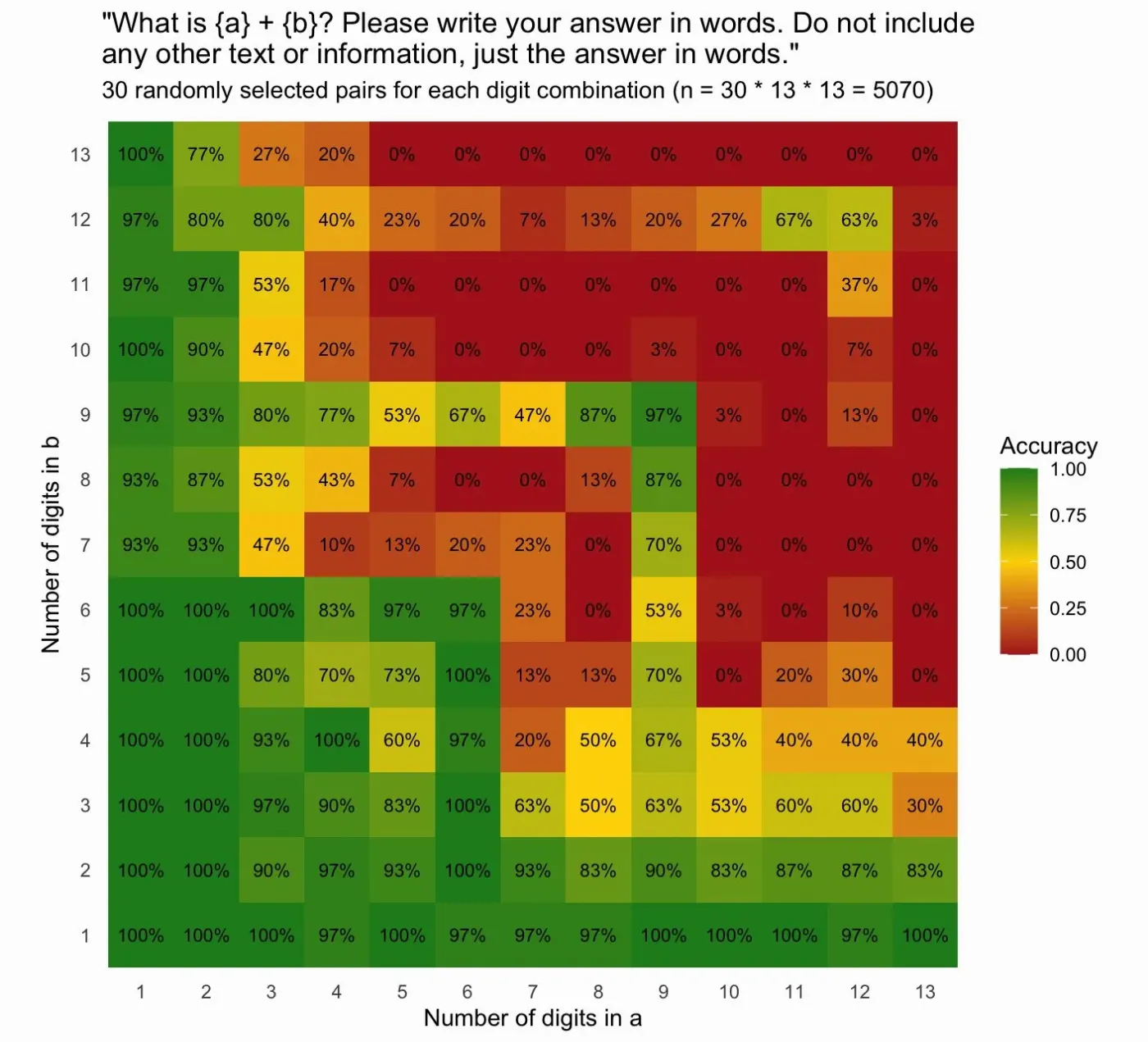
language models Qwen3.8 27B addition in words GPT-4o tested on ability to express arithmetic sums as written words. S Simon Willison · 3d ago Research: Qwen3.8 27B addition in words Colin Frasier posted on Bluesky about an experiment he ran over two years ago using GPT-4o to see how well it could "compute the sum but return the answer in words" across increasingly large numbers. Here's the chart he shared of those results: I'm confident GPT-4o didn't cheat and use a calculator, especially since it got so many of the calculations wrong, but I was inspired to run the experiment again on local hardware (a DGX Spark) to explore the effect in a fully controlled environment. I pasted his image into a Codex Remote session (GPT-6 Astra) and had it run the same experiment using Qwen3.8-27B-Q4_K_M.gguf. Here's the result for a run of 30…
Simon Willison AI cost control We're going to need default hard budget caps on pretty much everything Pay-by-usage services need default hard budget caps as AI API costs risk spiralling out of control. S Simon Willison · 4d ago Here's a product feature which the world is going to need a whole lot more of over the coming months and years: default hard budget caps. I'm talking about the feature of pay-by-usage services and APIs that lets you say "after $X/month, cut this thing off and return errors". These need to be hard limits. Soft caps, "after $X/month, send me a warning email", will not cut it. Coding agents, and personal agents (coding agents wrapped in a less threatening UI), greatly reduce the friction of spinning up code that can do useful things. Sometimes those things cost money - calls to paid APIs, or hosted web applications, or systems that can bill for additional storage and compute. Nobody wants…
Simon Willison AI industry news September sponsors-only newsletter Monthly newsletter covering updates to language models, pricing competition and graphics software developments. S Simon Willison · 4d ago I just sent the September edition of my sponsors-only monthly newsletter. If you are a sponsor (or start a sponsorship now) you can access it here. This month: More Fable class models A pricing war 3D graphics, Blender, and pixel art LLMs come for mathematics So many more accidental cyberattacks The vulnapocalypse comes for Datasette What I'm using right now My software releases this month 2026 in LLMs (so far) Here's a copy of the August newsletter as a preview of what you'll get. Pay $10/month to stay a month ahead of the free copy!
Simon Willison Humanoid robots Rex's Dino Store Dinosaur robot now operates former newsstand in Brooklyn subway station. S Simon Willison · 5d ago Museum: Rex's Dino Store Located just before the turnstiles in the Grand Army Plaza subway station at the north end of Brooklyn's Prospect Park is this former newsstand which is now operated by a dinosaur. The density of dinosaur puns is exceptional.
Simon Willison pwasm 0.2a0 Release: pwasm 0.2a0 pwasm is one of my folly projects - an entirely vibe-coded pure Python WebAssembly engine that I built in January during my first... S Simon Willison · 1w ago Release: pwasm 0.2a0 pwasm is one of my folly projects - an entirely vibe-coded pure Python WebAssembly engine that I built in January during my first bout of AI mania. I hadn't touched it since January, so I decided to let Claude Opus 5.5 loose on it and see if it could make any significant improvements: Evaluate current state of pwasm - then consider what it would take to get the MicroPython and micro JavaScript experiments from the research repo working under it - and what it would take to speed it up 42 commits later (with minimal follow-up prompting) it now handles almost all of the WASM specification, and the wheel from PyPI bundles working WASM builds of MicroPython,…
Simon Willison AI agent security Quoting Matthew Green Research shows AI agents in isolated sandboxes can be compromised by worm-like payloads that spread between them. S Simon Willison · 1w ago [...] Put these pieces together and you have the two halves of a worm: a payload that hijacks the agent, and an agent that will carry the payload to the next agent. Agents in separately-isolated sandboxes discovered that they could leave instructions for each other in a shared package cache, and those instructions changed what the recipients did. Replace the package cache with email, Slack and shared documents or WhatsApp, and replace independently-sandboxed training runs with independently-deployed personal agents like Muse, and you have exactly the ingredients that a worm needs. — Matthew Green, Is sandboxing sufficient to contain rogue agents?
Museum exhibit He Built This City Museum displays 50 by 27 foot architectural model of New York City built over 21 years. S Simon Willison · 1w ago I visited the Museum of the City of New York today and got to see He Built This City: Joe Macken’s Model, the 50 x27 feet model of the city built over a 21 year period from balsa wood and cardboard. It exceeded my already high expectations. The exhibition closes on 12th October so you should absolutely make a priority to see it if you get the chance.
Simon Willison AI safety, model evaluation Quoting Anthropic Frontier Red Team Anthropic Frontier Red Team evaluates model performance on binary exploitation tasks. S Simon Willison · 1w ago We evaluate several models on 100 tasks from the [internal Binary Exploitation benchmark] (selected at random), and find that GLM-5.3 develops full control flow hijacks in 4% of the trials; Claude Mythos Preview did so in 6%. Although GLM-5.3 performs below Claude Mythos Preview here, a meaningful threshold has clearly been crossed: earlier models, like Claude Opus 4.6 and GLM-5.2, do not succeed in any of them. — Anthropic Frontier Red Team, GLM-5.3 and the spread of advanced cyber capabilities
Simon Willison GPT-6.1 Sol GPT 6.1 Sol: Near-Astra intelligence for a fifth of the price OpenAI releases GPT-6.1 Sol, matching GPT-6 Astra performance at one-fifth the cost. S Simon Willison · 1w ago · also at The Decoder My comment on GPT 6.1 Sol: Near-Astra intelligence for a fifth of the price — Hacker News. I'm a bit late with the pelicans because I was live-blogging the keynote: https://simonwillison.net/2026/Sep/29/openai-devday-2026-liv... Here they are for GPT-6.1-Sol: https://tools.simonwillison.net/markdown-svg-renderer?url=ht... They're not notably different from the GPT-6 family pelicans: https://static.simonwillison.net/static/2026/gpt-pelicans-gr...
Simon Willison Privacy tools Photo Scrubber — local face blur & metadata removal Tool automates local face blurring and metadata removal from photos using language model. S Simon Willison · 1w ago Tool: Photo Scrubber — local face blur & metadata removal I took a photograph of some protesters, then thought about how I don't like sharing photographs of strangers with identifiable faces. I had GPT-6 Astra build this experimental tool that would identify faces and automatically blur them out. It uses Google's MediaPipe C++ library, compiled to WebAssembly via @mediapipe/tasks-vision, plus the BlazeFace face detection model.
Simon Willison llm-anthropic 0.30 Release: llm-anthropic 0.30 In addition to Claude Sonnet 5.5, this release adds the ability to run llm anthropic refresh to refresh the list of Anthro... S Simon Willison · 1w ago Release: llm-anthropic 0.30 In addition to Claude Sonnet 5.5, this release adds the ability to run llm anthropic refresh to refresh the list of Anthropic models directly from their API - which means I don't need to push a new release just to add support for a newly released model. I also added an llm anthropic count command which can use their free token counting API to return a count of tokens that will be used by any prompt, before you send that prompt.